By Dr. Stefano Sinicropi, MD Founder, The HyperCharge Human Engineering Lab
A Human Engineering Protocol for Conquering the “Winter Blues”
EXECUTIVE SUMMARY
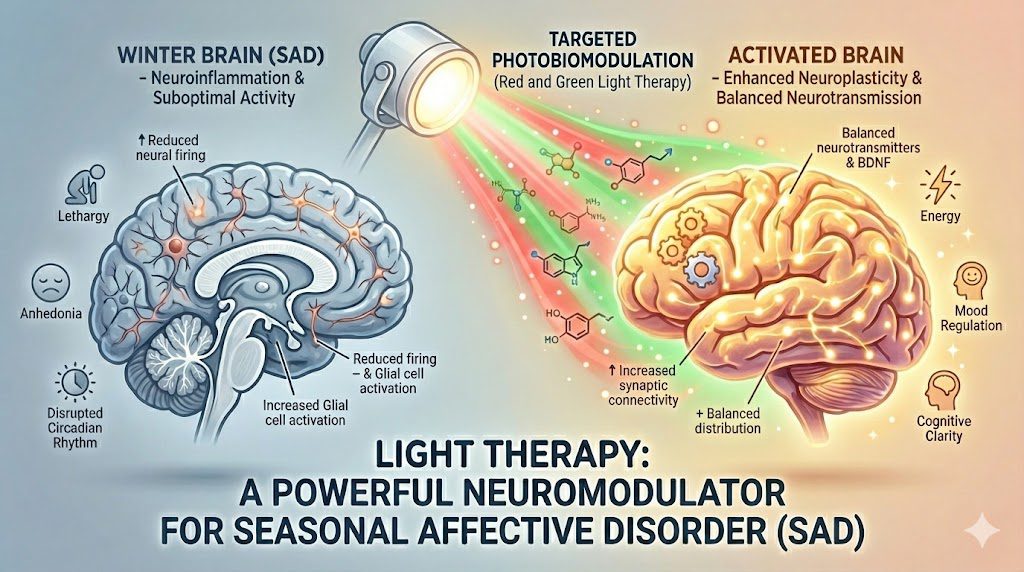
As we enter the darker months in the North, millions of people experience a profound physiological shift. Energy plummets. Carbohydrate cravings spike. Motivation evaporates.
The medical establishment labels this Seasonal Affective Disorder (SAD). They treat it as a psychiatric condition (“Depression”), often prescribing SSRIs to manipulate serotonin chemically.
This approach is fundamentally flawed. SAD is not a software glitch (Psychology). It is a hardware power failure (Physics). Human beings are solar-powered organisms living in a light-deficient environment. When you remove the primary energy source (The Sun) from the system, the battery dies and the timing belt slips.
This paper outlines the HyperCharge Protocol for Seasonal Resilience: A bio-physical strategy utilizing Polychromatic Light Therapy, Transcranial Laser Therapy, and Neurotransmitter Supply Chain Optimization to artificially restore the solar environment and keep the human machine running at peak performance.
1. THE ETIOLOGY: CIRCADIAN PHASE DELAY
To fix the problem, we must understand the mechanism. It isn’t just “sadness”; it is a timing error.
A. The Evolutionary Mismatch Our biology is ancient. For 200,000 years, shorter days signaled Famine and Cold. When light hits the retina, it travels to the Suprachiasmatic Nucleus (SCN)—the Master Clock in the hypothalamus.
- In Summer: High-intensity morning light sets the clock to “Active Mode.”
- In Winter: The low light signal causes a Circadian Phase Delay. The internal clock runs slower than the 24-hour day. Your brain thinks it is 4 AM when it is 8 AM.
B. The Result: “Hibernation Mode” Because of this delay, the brain overproduces Melatonin (sleep hormone) during the day and fails to produce Serotonin (mood/energy). You are fighting your own biology. The body wants to hibernate; the modern world demands performance. The friction between these two realities is what we call “Depression.”

2. THE HYPERCHARGE PROTOCOL: LIGHT AS A DRUG
We do not use generic “happy lamps.” We use targeted frequencies to hit specific biological switches. This is Dosimetry, not decoration.
A. THE CIRCADIAN RESET: GREEN LIGHT THERAPY (520nm)
Standard “Blue Light” boxes work, but they are harsh. They cause eye strain and retinal toxicity.
- The Engineering Fix: We utilize Narrow-Band Green Light.
- The Mechanism: Green light targets the Retino-Thalamic Pathway and intrinsically photosensitive retinal ganglion cells (ipRGCs). It triggers the circadian “Phase Advance” (waking up the clock) just as effectively as blue light, but without the toxicity or visual stress [1].
- The Outcome: A 15-minute exposure in the morning hits the “Wake Up” button on the SCN, suppressing melatonin and spiking cortisol/serotonin for the day.
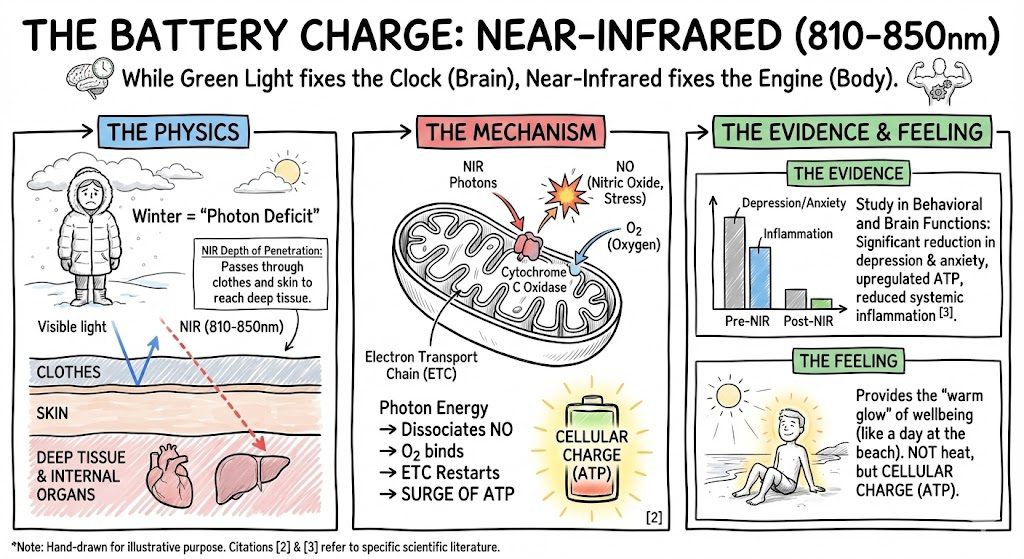
B. THE BATTERY CHARGE: NEAR-INFRARED (810-850nm)
While Green Light fixes the Clock (Brain), Near-Infrared fixes the Engine (Body).
- The Physics: Winter creates a “Photon Deficit.” We wear coats; we stay inside. Our mitochondria are starved of solar radiation. Near-Infrared (NIR) light is unique because of its Depth of Penetration. Unlike visible light, NIR passes through clothes and skin to reach deep tissue and internal organs.
- The Mechanism: NIR is absorbed by Cytochrome C Oxidase in the mitochondria. This surge of photon energy dissociates Nitric Oxide (the stress molecule) and allows Oxygen to bind, restarting the Electron Transport Chain [2].
- The Evidence: A pivotal study in Behavioral and Brain Functions demonstrated that NIR therapy significantly reduced symptoms of depression and anxiety by upregulating ATP production and reducing systemic inflammation [3].
- The Feeling: This provides the “warm glow” of wellbeing that you feel after a day at the beach. It is not heat; it is cellular charge (ATP).
C. THE COGNITIVE SHIELD: TRANSCRANIAL PHOTOBIOMODULATION (tPBM)
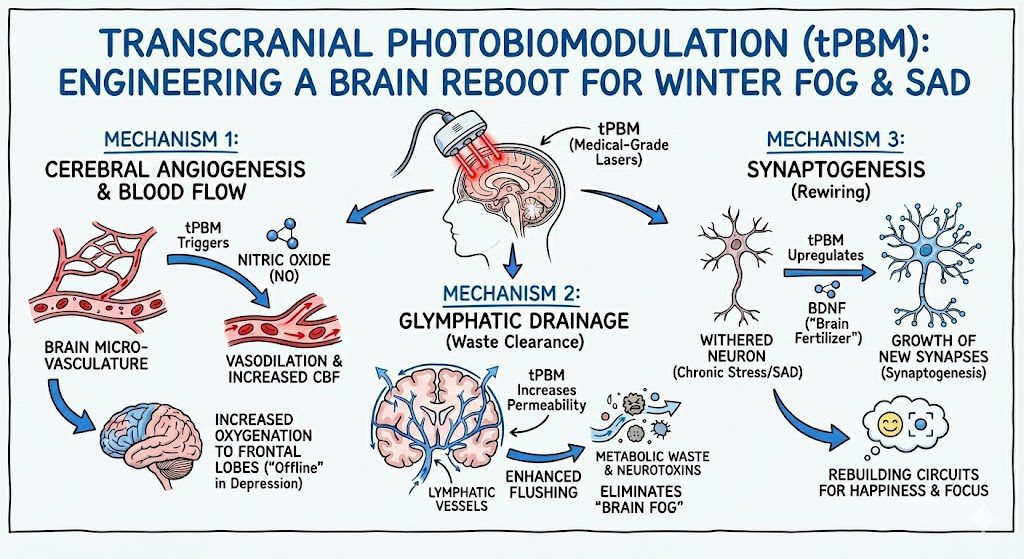
This is the missing link in standard SAD treatment. Winter isn’t just about “mood”; it’s about “Winter Fog”—the cognitive slowing and lack of focus. This is a result of Hypo-Metabolism in the prefrontal cortex. We use medical-grade lasers applied directly to the skull to engineer a brain reboot.
- Mechanism 1: Cerebral Angiogenesis & Blood Flow tPBM triggers the release of Nitric Oxide in the brain’s micro-vasculature. This dilates the blood vessels, increasing Cerebral Blood Flow (CBF) and oxygenation to the frontal lobes, which are often “offline” in depression [4].
- Mechanism 2: Glymphatic Drainage The brain has a waste-clearance system called the Glymphatic System. When we are sedentary and light-deprived, this system stagnates. tPBM increases the permeability of the lymphatic vessels, physically flushing out metabolic waste and neurotoxins that cause “brain fog” [5].
- Mechanism 3: Synaptogenesis (Rewiring) Chronic stress/SAD causes neurons to wither (atrophy). tPBM upregulates Brain-Derived Neurotrophic Factor (BDNF), which acts as “fertilizer” for the brain, promoting the growth of new synapses (Synaptogenesis). We are literally rebuilding the circuits for happiness and focus [6].
3. THE BIOCHEMICAL SUPPORT: FUELING THE ASSEMBLY LINE
Physics starts the reaction; Chemistry provides the building blocks.
Standard medicine prescribes SSRIs. These drugs do not create new serotonin; they simply hoard what little you have left. This is a Scarcity Model. We use an Abundance Model. We provide the raw materials (substrate) so your body can manufacture the neurotransmitters it needs.
A. The Vitamin D “Hammer” (Plus Co-Factors)
Vitamin D is a Secosteroid Hormone that regulates dopamine production. In Minnesota winters, you are biologically offline.
- The Fix: We aim for Optimal Levels (60-80 ng/mL).
- The Critical Detail: High-dose Vitamin D requires Vitamin K2 (to direct calcium to bones, not arteries) and Magnesium (for activation). Without the co-factors, the D doesn’t work [7].
B. Brain Bioenergetics: Creatine Monohydrate
Most people think Creatine is for bodybuilders. It is actually a powerful Nootropic (Brain Fuel).
- The Mechanism: The brain demands massive amounts of ATP. Creatine recycles ATP in neurons, providing a rapid energy buffer.
- The Evidence: Studies show Creatine supplementation significantly enhances mood and cognitive function in cases of “Brain Energy Deficit” (like SAD and Depression) [8]. It keeps the lights on when the grid is struggling.
C. The Precursor Protocol (Amino Acids)
You cannot build a house without lumber. You cannot build Serotonin without Tryptophan/5-HTP.
- The Strategy: We supplement the precursor to ensure the assembly line has inventory.
- Safety Note: If you are currently taking an SSRI, consult our team before adding 5-HTP, as this requires medical management.
D. Peptide Therapy: The Software Update
For patients with severe cognitive decline or “Winter Fog,” we utilize advanced peptides.
- Semax / Selank: These neuropeptides increase the expression of BDNF. They protect neurons from inflammatory stress and improve mood/focus without the jittery side effects of stimulants.
4. CONCLUSION
You do not have to “just deal with it.” You do not have to gain 10 pounds and lose your edge every winter.
Seasonal Affective Disorder is a signal that your environment has become toxic to your biology. You cannot change the latitude of Minneapolis, but you can engineer your internal environment.
Stop managing the decline. Engineer the light.
SCIENTIFIC BIBLIOGRAPHY
- Ibrahim, M. M., et al. (2017). “Long-lasting antinociceptive effects of green light in acute and chronic pain.” Pain.
- Hamblin, M. R. (2016). “Photobiomodulation or low-level laser therapy.” Journal of Biophotonics.
- Schiffer, F., et al. (2009). “Psychological benefits 2 and 4 weeks after a single treatment with near-infrared light to the forehead: a pilot study of 10 patients with major depression and anxiety.” Behavioral and Brain Functions.
- Salehpour, F., et al. (2018). “Brain Photobiomodulation Therapy: a Narrative Review.” Molecular Neurobiology.
- Zinchenko, E., et al. (2019). “The effects of photobiomodulation on the lymphatic system: promising treatment for lymphedema and neurodegenerative diseases.” Lasers in Medical Science.
- Xuan, W., et al. (2015). “Transcranial low-level laser therapy improves neurological performance in traumatic brain injury in mice: effect of treatment repetition regimen.” PLOS ONE.
- Spedding, M. (2014). “Vitamin D and depression: a systematic review and meta-analysis comparing studies with and without biological flaws.” Nutrients.
- Kondo, D. G., et al. (2011). “Open-label adjunctive creatine for female adolescents with SSRI-resistant major depressive disorder.” Journal of Clinical Psychiatry.